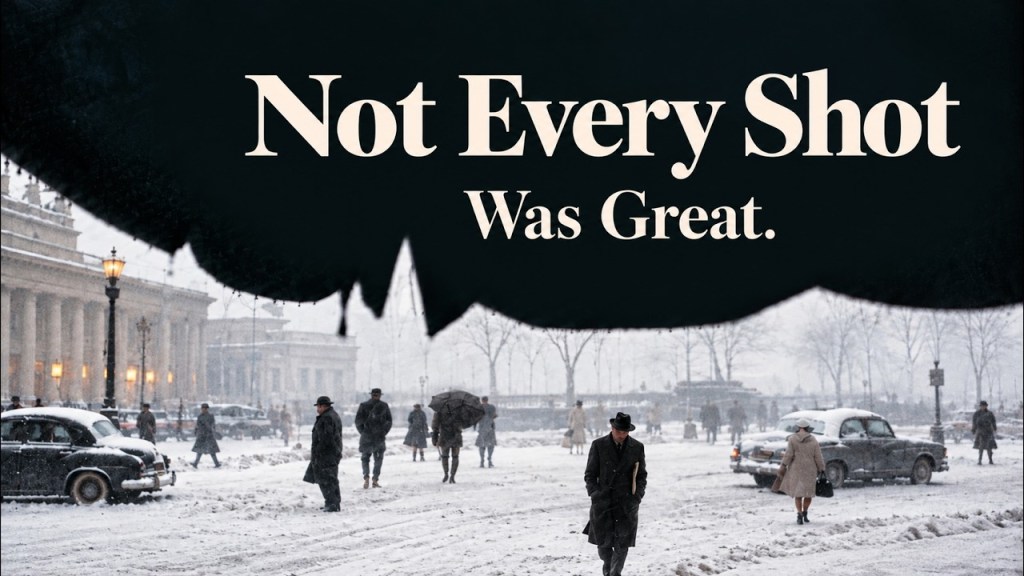
Here is a confession that will not surprise anybody who has ever carried a camera for more than a week. Some days I come home, look at what I shot, and decide the whole card, the whole day, was a waste of time. Seventy five frames. Nothing. At least that is what my brain tells me on the walk home.
If that sounds familiar, I have homework for you, and it is the opposite of what the internet usually prescribes. Do not watch another tutorial. Do not buy another preset. Go get a book. A real book, by a photographer you actually admire, and spend an evening turning pages slowly, the way people used to do before every picture had to fight for attention in a feed.
Mine, more often than not, is Saul Leiter. I am not breaking new ground by saying that. Everybody claims Leiter. Everybody should. And here is the strange, wonderful thing that happens when you sit with his work for a while. You start recognizing yourself in it. Not the famous frames. The quiet ones. The ordinary street corners. The reflections. The pictures that look, at first glance, like something you shot last Tuesday and immediately dismissed.
That recognition is supposed to be comforting, and it is, once you get past the first sting of it. Because a book like Leiter’s is not a greatest hits album. It is closer to a life laid out in pictures, including the ones that were simply interesting, simply observed, simply liked by the man who pressed the button. He was not trying to win photography every time he raised a camera. He was paying attention. There is a difference, and it matters more than most of the advice floating around right now.
Context helps here, and the context has changed completely. When Leiter was working, the audience for a picture was small. Family in a living room. A local group, if you were serious enough to join one. The number of people making pictures was, relatively speaking, tiny. Call it a million, give or take, and that already feels generous.
Now? Everybody. A billion people with a camera in a pocket, all publishing in the same giant room, all at once. Your picture does not just have to be good. It has to survive being placed next to ten thousand other good pictures before breakfast. No wonder it feels harder to stand out. The room did not just get bigger. It exploded.
So we need a fairer way to judge, starting with other people’s work and ending with our own. Think about speed, because everybody understands speed. There was a time when Jesse Owens was the fastest human being on the planet, full stop, gold medals and all. Every one of his records has since been broken. That does not retroactively make him slow. It means the sport moved on, the training moved on, the whole world moved on. A photograph works the same way. You cannot honestly grade a picture made in the 1950s by the standards of a 2026 feed and then act surprised when it looks different. Different is not worse. Different is just honest.
Apply that same fairness to yourself, because this is where most of us cheat. You shoot 75 pictures on a grey afternoon, you like none of them, and then you compare that one grey afternoon to a master who had a lifetime to accumulate a book. That is not a contest. That is a setup. You are supposed to lose that comparison, and losing it tells you nothing about whether you can actually see.
This channel, if I am being straight with you, started as something much smaller and more personal than a brand or a business. I wanted a record. Something my kids and grandkids could find later and use to answer a simple question: what was Dad, what was Poppy, actually doing all those years? Answer: out on the street with a camera, looking, shooting, coming home and doing it again. If a stranger someday flips through my pictures the way we flip through Leiter’s, wonderful. If not, the record still exists, and that was the point all along.
Which brings us, inevitably, to the gatekeepers. I have already said my piece about them in a whole video, and my mind has not changed since. Gatekeeping is not just policing a genre from the outside. It is also the quieter, crueller version: telling a photographer, directly or by implication, that their work does not clear some invisible bar. Now go back to that Leiter book. Look at all those ordinary, interesting, human pictures, many of them gathered up and published long after he was gone, and then try to tell me with a straight face that only masterpieces count. I will give you a minute. Take two.
William Eggleston belongs in this conversation too, for the same reason. Another photographer who shot what caught his eye and trusted that instinct enough to keep going. No permission slip required. No committee vote. Just attention, repeated for a lifetime, until the work added up to something bigger than any single frame.
So here is where I land, and it is deliberately simple. A photograph is a second that will never repeat itself. That is the whole trick, and it is a pretty good trick. It may get lost in the river. Right now that river is a billion pictures wide, and it is only getting wider. But it caught your eye for a reason, in that moment, and that reason is enough to justify pressing the button. Shoot what you like looking at. Keep a book nearby. And stop letting a comments section convince you that your pictures are bad just because they are not famous yet. Or ever. Famous was never the job. Seeing was.


Leave a Reply